We live in an age in which religion is often judged through the behaviour of those who claim to represent it. Wars, extremism, discrimination and violence are sometimes accompanied by the name of God, leading some to believe that faith itself is the problem.
Yet a clear distinction must be made between religion and the way in which some people use religion.
A person who invokes the name of God does not automatically become a person of God.
In Islam, mercy, altruism, justice and respect for others are not concepts introduced later in order to adapt religion to modern society. They belong to its very sources.
The Qur’an, addressing the Prophet Muhammad ﷺ, states:
“We have sent you only as a mercy to the worlds.” (Qur’an 21:107)
In relations with others, the Qur’an calls for kindness towards parents, relatives, orphans, those in need and also towards the neighbour who is a stranger (Qur’an 4:36).
Altruism is expressed in equally powerful terms: “They give preference to others over themselves, even though they may be in need.” (Qur’an 59:9).
Even where profound disagreements exist, believers are not given permission to abandon justice:
“Do not let the hatred of a people lead you away from justice. Be just; that is nearer to righteousness.”(Qur’an 5:8)
Regarding relations with those belonging to other communities, the Qur’an also states:
“Allah does not forbid you from being kind and just towards those who have not fought you because of religion.”(Qur’an 60:8)
This is accompanied by one of the best-known Qur’anic principles:
“There is no compulsion in religion.”(Qur’an 2:256)
These principles allow us to address an issue of particular importance to contemporary European societies: the relationship between faith and the secular State.
The European Muslims League does not advocate a confessional State, nor does it believe that religion should be imposed through public institutions. Secularism should provide a common space in which Muslims, Christians, Jews, followers of other religions and non-believers can live with equal rights, equal duties and equal dignity.
But secularism does not mean the absence of morality.
Separating the State from religion does not mean separating justice from conscience. When economic interests, quantitative targets, efficiency or power become more important than justice and human dignity, simply stating that “the State is secular” does not answer the fundamental question.
That question remains the same for believers and non-believers alike:
Is what we are doing just?
A secular State can commit an injustice just as a society describing itself as religious can commit an injustice. No label can automatically guarantee the morality of human behaviour.
And when a society recognises a particular religious tradition among its historical and cultural roots, it should also have the courage to compare its conduct with the moral values it claims to have inherited. References to Christian, Islamic, Jewish or other ethical traditions have meaning when those values find expression in justice, responsibility and respect for the human person.
At the same time, genuine secularism should not require citizens to erase their religious identity in order to participate fully in society.
The State must not impose faith, but neither should it impose the absence of faith.
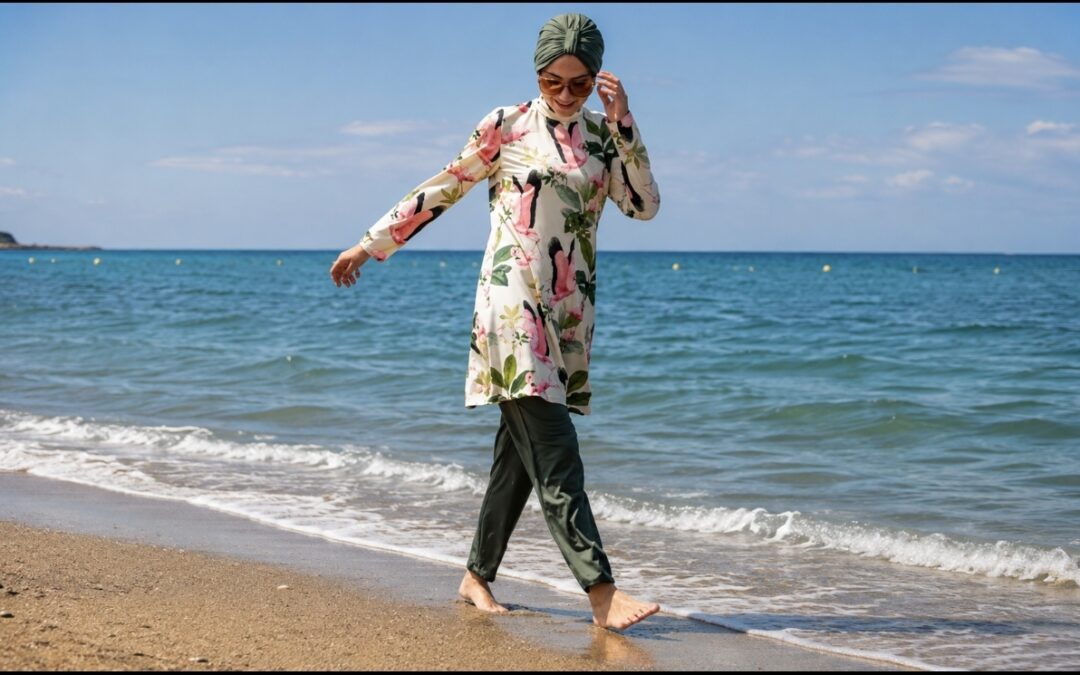
The European Muslims League has defended this principle in European forums, including in discussions concerning the burkini, the swimsuit chosen by some Muslim women to enable them to enjoy beaches and swimming pools while remaining consistent with their religious convictions and personal sense of modesty.
The principle is simple: if a woman is free to choose to wear a bikini, another woman must also be free to choose to wear a burkini, when that decision is genuinely her own.
Freedom cannot be defined only as the choice that corresponds to our own cultural model.
A Muslim woman who freely chooses to wear a burkini and, precisely because she has that possibility, leaves her home, goes to the beach, swims, practises sport and participates in social life should not automatically be considered less emancipated. On the contrary, that choice may represent for her an instrument of participation and personal freedom.
Forcing her to uncover herself in order to make her “free” would risk creating a profound paradox: restricting her freedom in the name of freedom itself.
Naturally, every individual freedom may be subject to necessary limitations for security and the protection of the rights of others. Such limitations, however, must be justified and proportionate and must not become a means of discriminating against a particular community.
A truly secular State does not decide which faith its citizens should follow, but neither does it decide how much of their faith they must erase in order to be considered free.
There is, however, an opposite danger.
Religious freedom cannot become a justification for fanaticism, coercion or discrimination. Throughout history, some people have used religion to pursue personal, political, economic or even criminal interests. Others have hidden behind sacred words and symbols to promote hatred, division and fear.
This phenomenon does not belong to one religion alone. It belongs to human beings whenever they instrumentalise faith.
A Muslim who commits an injustice does not make that injustice Islamic. A Christian who commits an injustice does not make that injustice Christian. A Jew who commits an injustice does not make that injustice Jewish.
The problem is not the person who takes faith seriously. The problem is the person who uses faith to justify what that very faith would forbid.
It is precisely here that one of the Qur’an’s most significant principles for our time emerges. Allah says:
“And thus We have made you a balanced community (ummatan wasaṭan).”
(Qur’an 2:143)
The concept of wasaṭ evokes balance, moderation and the middle way.
It does not mean having a weak faith, nor does it mean abandoning one’s principles in order to adapt to every change in society.
It means avoiding extremes: being deeply committed to one’s faith without becoming fanatical; defending one’s identity without denying the identity of others; recognising rights without forgetting duties; defending freedom without turning it into an absence of responsibility; and pursuing justice without losing mercy.
Religion must not take possession of the State, and the State must not take possession of the human conscience.
Between these two extremes lies the space of freedom, responsibility and peaceful coexistence.
Muslims, Christians, Jews and people belonging to other traditions may have profound theological differences. These differences do not need to be erased in order for us to live together. Genuine respect lies precisely in recognising differences without turning them into hostility.
The European Muslims League believes that the future of our societies does not require less faith, but a more authentic, conscious and responsible faith; nor does it require less secularism, but a secularism genuinely capable of protecting everyone.
The path of balance is not a compromise between good and evil. It is strong faith without fanaticism, secularism without hostility towards religion, freedom accompanied by responsibility, and an identity that does not need to erase the identity of another.
Because genuine coexistence does not begin when we all become the same.
It begins when we learn to live together, different, with the same dignity.
The Path of Balance: Faith, Secularism and Freedom