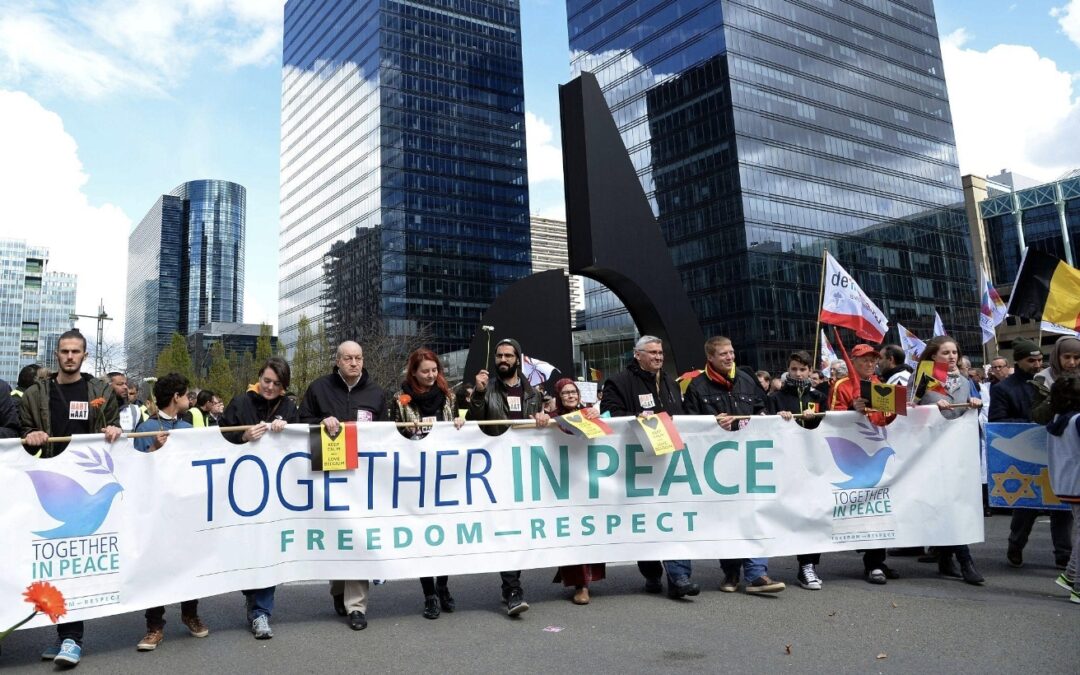
Institutions, religions, young people and communities share a common responsibility
At a time marked by wars, social tensions, and cultural and religious divisions, speaking about peace cannot simply mean calling for an end to conflicts. Peace must be built every day, through trust between citizens, institutions and communities.
Institutions have a fundamental responsibility: to guarantee security, justice, religious freedom and equal dignity. Religious communities and civil society also have an important role: to promote respect, encourage dialogue and prevent differences from becoming a source of fear or confrontation.
Differences Must Not Become Divisions
Our societies are made up of people with different cultures, religions and traditions.
Muslims, Christians, Jews, followers of other faiths and people with no religious affiliation share the same cities, schools, workplaces and institutions.
Dialogue does not mean giving up one’s identity. On the contrary, it means getting to know others while preserving one’s own identity, learning to live together with respect for differences and common rules.
A strong society is not one in which everyone thinks alike, but one capable of transforming diversity into cooperation.
Young People Must Meet Before Prejudices Take Root
We have a particular responsibility towards younger generations.
Schools, sport, culture and volunteering can create opportunities for young people from different families, religions and countries to meet and get to know one another directly.
When a young person plays on the same team as another, they do not first see a religion, nationality or origin. They see a teammate.
It is through simple experiences such as these that a culture of peace can begin.
The Role of Municipalities and Institutions
Peaceful coexistence is built first and foremost in our cities.
Municipalities are often the first institutions called upon to deal directly with integration, challenges affecting young people, security, education and relations between different communities.
For this reason, cooperation among local authorities, schools, associations, sports organizations and religious communities is also a concrete means of preventing conflict and social division.
International peace and peace within our cities are not entirely separate realities. Both require listening, responsibility, respect and trust.
Religions Can Build Bridges
Religions have a particular responsibility.
When Muslims, Christians and Jews are able to meet without giving up their own faith, they demonstrate that religion can be part of the solution rather than part of the problem.
Interfaith dialogue should not be limited to conferences. It must reach our cities, schools, sports activities and the places where people live their everyday lives.
Getting to know one another reduces fear. And reducing fear means leaving less space for hatred.
From Words to Action
The European Muslims League (EML) considers dialogue not simply a declaration of principle, but a concrete responsibility.
Initiatives such as “Kick War Away – Un Calcio alla Guerra” seek to transform these values into action by bringing together young people, athletes, municipalities, institutions and representatives of different religions and cultures.
A peace march, a football match or a meeting between institutional representatives cannot, by themselves, stop a war.
But they can build something without which no peace can last: trust between people.
From this trust can grow stronger relations between communities, cooperation between cities and, one day, new relationships between peoples and States.
Peace does not belong to one religion, one country or one institution.
Peace is a shared responsibility.
Peace Begins with Trust