The European Muslims League strengthens its European action to document Islamophobia, counter disinformation and promote dialogue, responsibility and equality before the law
There was a time when the term “Islamophobia” could be dismissed by some as an expression invented by activists or as a tool used to prevent any criticism of Islam.
Today, the figures tell a reality that is much harder to ignore.
Across several European countries, Muslims are reporting discrimination, harassment, threats, attacks and obstacles in their daily lives. This is not merely about arguments on social media or offensive words. The phenomenon also affects employment, access to housing and services, personal safety and, in some cases, places of worship.
It is within this context that the European Muslims League (EML) intends to strengthen its European action against anti-Muslim hatred, disinformation and the manipulation of Islamic sources, through an approach based on fact-checking, institutional dialogue and responsibility.
Almost one in two Muslims reports experiencing discrimination
The European Union Agency for Fundamental Rights (FRA), in a major survey involving 9,604 Muslims across 13 European Union countries, found that 47% of respondents had experienced racial discrimination during the previous five years.
27% had experienced racist harassment, while 4% reported incidents of racist violence.
The differences between countries are significant. Austria recorded the highest level of reported discrimination, at 71%, followed by Germany at 68%. Finland recorded the highest level of racist harassment, at 49%.
These figures demonstrate that the problem cannot simply be reduced to individual perceptions or political controversy.
Germany: more than 11 incidents a day
The figures from Germany are particularly concerning.
According to CLAIM, the German Alliance Against Islamophobia and Anti-Muslim Hate, 4,096 anti-Muslim incidents were documented in 2025, representing an increase of 33% compared with 3,080 the previous year.
That means more than 11 documented incidents every day.
These included 2,379 verbal attacks, 840 cases of discrimination and 689 incidents classified as harmful behaviour, including physical assaults and property damage. There were also 214 cases of bodily injury, five cases of arson and two homicides.
Behind every statistic there is a person, a family or a community.
Britain and France: equally worrying signs
The situation in England and Wales also deserves attention.
Figures from the UK Home Office recorded a 19% increase in religious hate crimes targeting Muslims, rising from 2,690 to 3,199 in the year ending March 2025. The Metropolitan Police is excluded from the year-on-year comparison because of a change in its crime-recording system.
In France, figures from the Ministry of the Interior indicate an 88% increase in anti-Muslim acts in 2025, with 326 incidents recorded.
These figures come from different countries and were collected using different methodologies, so they should not simply be added together. Taken collectively, however, they point to a European phenomenon that cannot be underestimated.
When a mosque is attacked, a community is attacked
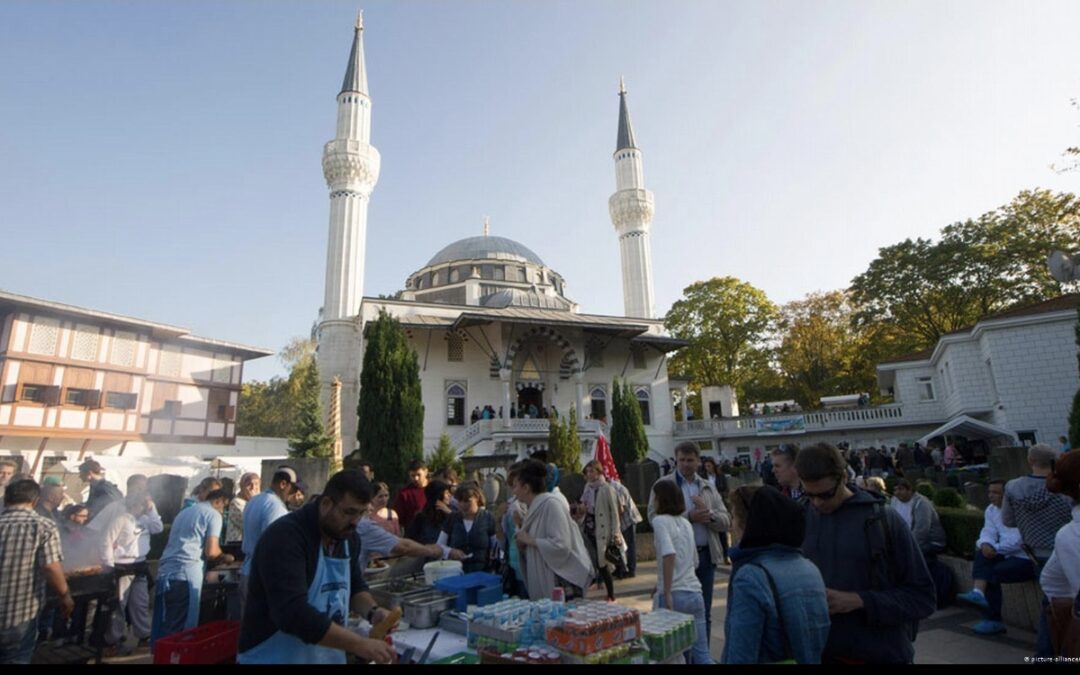
A mosque is not simply a building.
It is a place of worship, education, gathering and social support. When a mosque is vandalised, threatened or attacked, the message does not concern only walls, doors or windows: it reaches an entire community.
But the response cannot be to build even higher walls between Muslims and European society.
It must be exactly the opposite.
“We cannot fight hatred with more hatred”
For the President of the European Muslims League, Ambassador Alfredo Maiolese, defending European Muslims must go hand in hand with defending the fundamental principles of the societies in which they live: the rule of law, democratic participation, education, social responsibility and peaceful coexistence.
“We cannot fight hatred with more hatred. We must respond with facts, with the law, with education and with dialogue. Defending the dignity of Muslims also means defending a society in which no person is collectively judged because of their religion.”
The EML believes that European Muslims should participate fully in the civic life of the countries in which they live, working alongside municipalities, national institutions, schools, universities, associations and other religious communities.
Islamic identity and European citizenship are not incompatible concepts.
Responsibility is individual, not religious
There is a simple principle that should apply to everyone.
If a Muslim commits a crime, that individual is responsible.
If a Christian commits a crime, that individual is responsible.
If an atheist commits a crime, that individual is responsible.
Religion must not become a collective criminal record.
Countering Islamophobia therefore does not mean demanding immunity from criticism, excusing criminal behaviour because the perpetrator happens to be Muslim, or seeking privileges unavailable to other citizens.
It means demanding equality before the law and equal dignity within society.
Disinformation also fuels prejudice
Hatred does not arise from violence alone.
It can also be fuelled by the systematic repetition of false information, quotations stripped of their context, manipulated images and content designed to portray millions of people as a collective threat.
Criticism of Islam, like criticism of any religion, is part of freedom of expression.
Falsifying facts is something entirely different.
For this reason, the European Muslims League intends to pay particular attention to verifying information circulated through the media, websites and social media platforms, always distinguishing between legitimate criticism, disinformation and incitement to hatred.
Responding to one falsehood with another does not serve the truth.
Responding to hatred with hatred does not serve peace.
Talking with Muslims, not only about Muslims
Too often in Europe, people talk about Muslims without talking with Muslims.
Politicians debate Muslims. Newspapers debate Muslims. Institutions develop policies concerning Muslims. Security agencies analyse phenomena involving Muslim communities.
Yet those who live the daily experience of being both Muslim and European do not always have a place in that same debate.
The EML wants to help bridge this gap.
Not by replacing public institutions, but by creating opportunities for cooperation and shared responsibility.
Document, verify, act and engage
The European Muslims League’s renewed action will be developed around several fundamental principles: documenting incidents of anti-Muslim hatred, verifying information, supporting an accurate representation of Islam, engaging with the media and public institutions, and encouraging greater Muslim participation in European civic life.
The security and dignity of Muslims are not merely a Muslim issue.
When a society begins to accept the collective blaming of a religious community, the problem concerns democracy itself.
European Muslims are not guests in Europe.
They live in European cities, raise their children in European schools, work in European hospitals, universities, factories and businesses, pay taxes and contribute to society every day.
They have the right to have their security and dignity protected.
But they also have a responsibility: to participate, to engage in dialogue and to contribute to the common good.
It is upon this balance between rights and responsibilities that the European Muslims League intends to build its action.
Not against anyone.
Together with European society.
European Muslims League – EML
11 Anti-Muslim Incidents a Day: Europe’s Muslims Organise Against the Wave of Hate