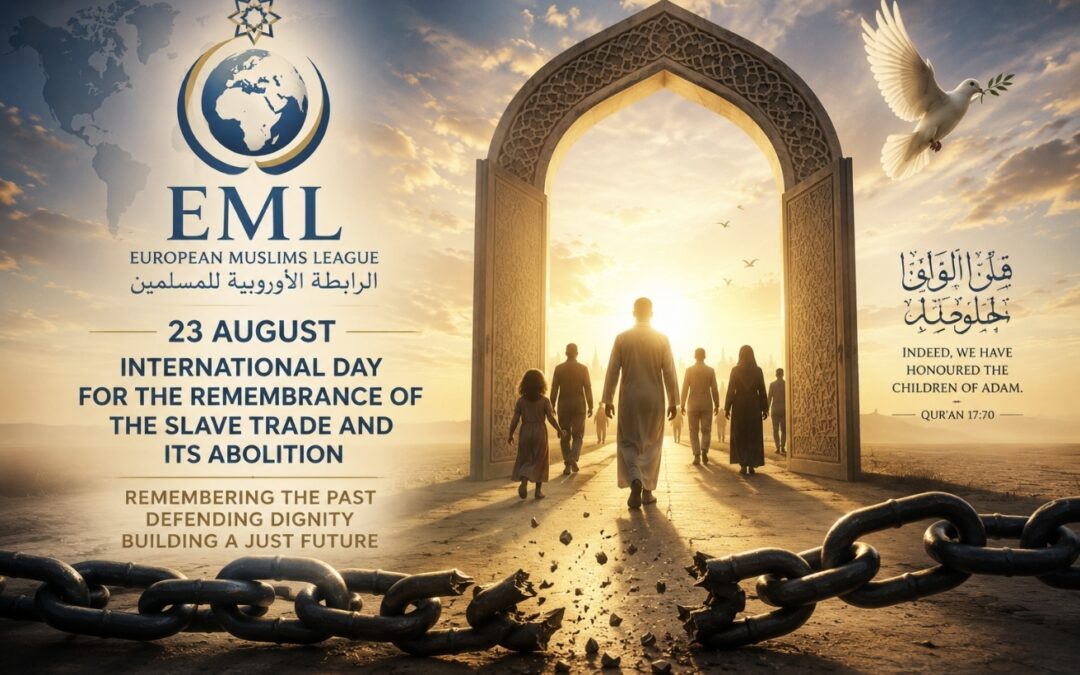
European Muslims League: remembering the slave trade means defending the freedom and dignity of every human being today
On the occasion of the International Day for the Remembrance of the Slave Trade and its Abolition, the European Muslims League (EML) joins the international community in remembering the victims of the slave trade and all those who, throughout history, have been deprived of their freedom and dignity.
For Muslims, this day also represents an opportunity to reflect on the importance that the Qur’an and the Prophetic tradition attach to the liberation of human beings, human dignity and responsibility towards the most vulnerable.
The Qur’an places the freeing of a slave among the deeds of the highest path:
“And what will make you realise what ˹attempting˺ the challenging path is? It is to free a slave.”
(Qur’an 90:12–13)
The freeing of slaves is also prescribed as a form of expiation in various circumstances. The Qur’an establishes, for example, the freeing of a believing slave as part of the expiation for accidental killing:
“Whoever kills a believer unintentionally must free a believing slave…”
(Qur’an 4:92)
A particularly significant principle also appears in verse 24:33, which addresses the possibility for a person in servitude to obtain emancipation through an agreement, accompanied by the moral obligation to provide financial assistance.
The Sunnah also contains teachings of great importance.
In an authentic hadith reported in Sahih Muslim, the Prophet Muhammad ﷺ teaches that whoever frees a slave will have, in return, the corresponding parts of his body freed by Allah from the Fire.
The Prophetic tradition also addresses the dignity of those who remained in servitude. In a well-known hadith reported in Sahih al-Bukhari and Sahih Muslim, the Prophet ﷺ teaches:
“Your servants are your brothers.”
He instructed Muslims to feed them from what they themselves ate, clothe them from what they themselves wore, and not burden them with work beyond their capacity; if such work was imposed upon them, they were to be helped.
Read within its historical context, this teaching establishes a fundamental principle: social condition does not erase fraternity, nor does it erase human dignity.
History must, however, be told in its entirety. Societies governed by Muslims also experienced slavery and the trade in human beings over the centuries. Recognising this does not mean accusing a religion, just as the crimes of the transatlantic slave trade cannot indiscriminately be attributed to Christianity.
It means distinguishing between religious principles, human conduct, and the political and economic systems that developed throughout history.
Today, this reflection has acquired an even greater urgency.
Slavery does not belong exclusively to history books. Human trafficking, forced labour, sexual exploitation, servitude and other contemporary forms of slavery continue to deprive men, women and children of their freedom.
For the European Muslims League, confronting these realities means translating into the present a principle deeply rooted in Islamic ethics: the dignity granted by God to the human being cannot become the property of another human being.
The Qur’an states:
“Indeed, We have honoured the children of Adam.”
(Qur’an 17:70)
Not one race, one people or one religious community: the children of Adam.
On this International Day, the European Muslims League therefore calls upon Muslims and non-Muslims alike to transform remembrance into a shared responsibility.
Remembering the victims of slavery also means defending those who today are still bought, sold, exploited or deprived of their freedom.
Human dignity has no colour, nationality or religion.
Defending it is everyone’s responsibility.
European Muslims League – EML
23 August – Islam, Human Dignity and Liberation from Slavery