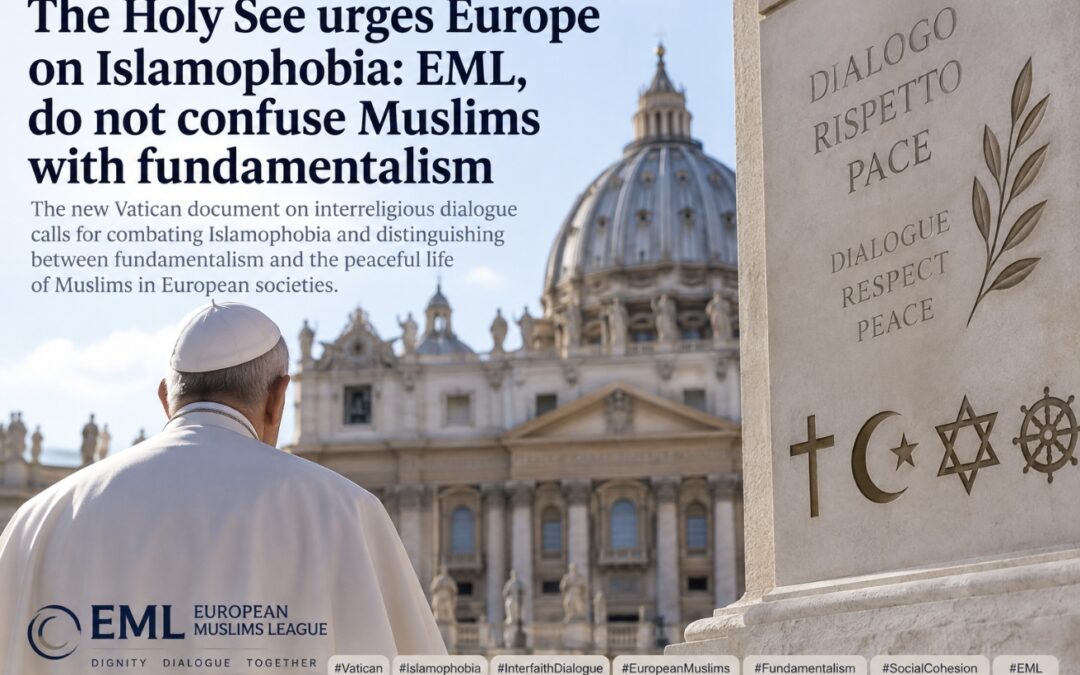
A recent Holy See document dedicated to interreligious dialogue draws attention to a particularly important principle for European societies: the need to combat Islamophobia without confusing fundamentalism and violence with the peaceful lives of Muslims integrated into European societies.
The European Muslims League (EML) considers this distinction essential to fostering a balanced debate on the Muslim presence in Europe.
Condemning terrorism, extremism and every form of violence committed in the name of religion cannot mean attributing collective responsibility to millions of Muslims who live, work and participate every day in European societies.
Likewise, combating Islamophobia does not mean preventing criticism of Islam. Criticism, even when severe, is part of freedom of expression when it is based on facts and does not turn into discrimination, generalisation or incitement to hostility.
It is precisely on this distinction that EML Islamophobia Watch – European Monitoring & Response Unit operates, according to the method:
Monitor. Verify. Document. Respond.
Its purpose is to verify facts, statements and information before reaching any conclusion. When criticism is well-founded, it should be acknowledged. When it is partially correct, facts must be distinguished from generalisations. When information, images or religious sources are manipulated to fuel hostility towards Muslims, this must instead be documented through verifiable sources.
– Combating fundamentalism and combating Islamophobia are not opposing objectives. Europe must be capable of defending security, the rule of law and religious freedom at the same time. We cannot allow the actions of extremists to become a collective responsibility attributed to millions of Muslims, just as we must not use the word Islamophobia to shield Islam from criticism. The response must always be the same: verify the facts and distinguish – said Alfredo Maiolese, President of the European Muslims League.
The Holy See’s message therefore also carries particular significance within the broader path of interreligious dialogue in Europe.
Christians, Muslims, Jews, followers of other religions and non-believers may have profound religious and cultural differences. Dialogue does not require those differences to disappear. It requires ensuring that they can coexist while respecting human dignity and fundamental freedoms.
Combating fundamentalism without turning it into condemnation of an entire religion, opposing Islamophobia without restricting freedom of criticism, and protecting religious freedom alongside security represent a shared responsibility for Europe’s future.
The Holy See Calls Europe’s Attention to Islamophobia: EML, Do Not Confuse Muslims with Fundamentalism