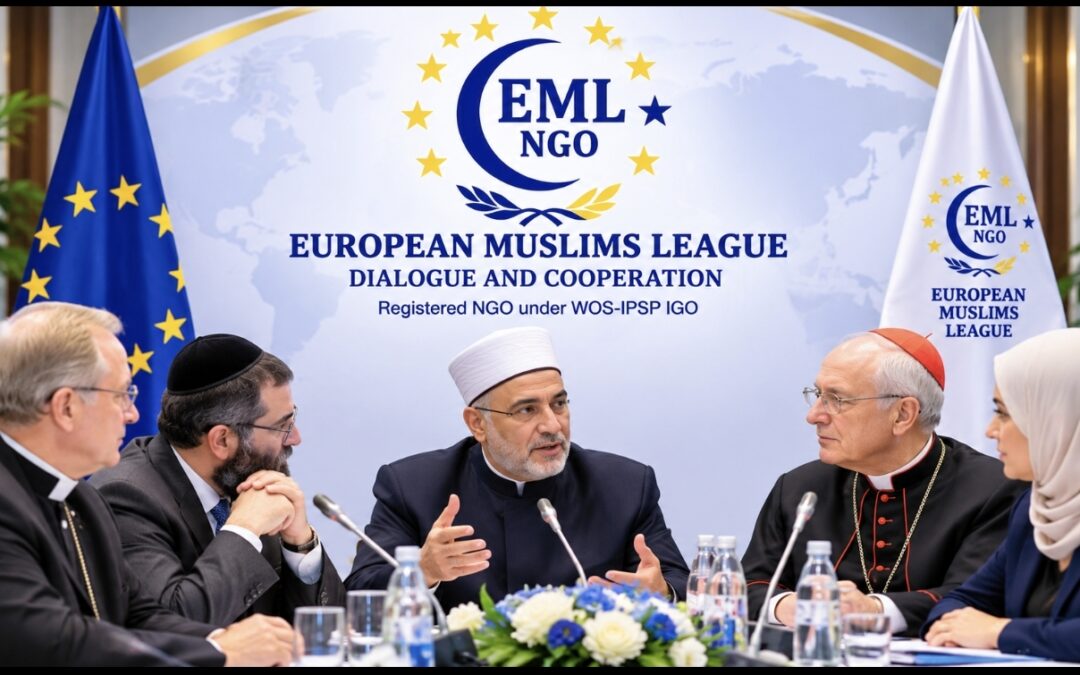
Building bridges between governments, religious communities and civil society through institutional independence, mutual respect and international cooperation.
Religious Independence as a Foundation for International Dialogue
In an international environment increasingly marked by political polarization, religious tensions and cultural divisions, the European Muslims League (EML) promotes an approach to international cooperation founded on institutional independence, respect for national sovereignty and the universal principles of human dignity.
Established in Genoa, Italy, on 10 May 2010, the European Muslims League is a non-governmental organization committed to promoting religious freedom, intercultural understanding, peaceful coexistence and cooperation among peoples.
Its mission is based on a fundamental conviction: religion should serve as a bridge between communities rather than an instrument of political confrontation.
EML maintains a non-partisan institutional identity, independent of political parties and ideological movements. This independence allows the organization to pursue dialogue with governments, religious authorities, international institutions and civil society organizations across different political, cultural and geographical contexts.
Such an approach does not imply indifference towards injustice or violations of fundamental rights. On the contrary, EML considers respect for human dignity, freedom of religion and peaceful coexistence essential principles that must be promoted through constructive engagement, international law and institutional cooperation.
Cooperation Beyond Political and Geographical Divisions
The European Muslims League recognizes that meaningful international cooperation requires the ability to communicate with institutions and communities whose political systems, cultural traditions and religious backgrounds may differ considerably.
Rather than approaching international relations through ideological confrontation, EML encourages dialogue based on mutual respect, institutional responsibility and the identification of shared objectives.
This philosophy enables the organization to promote initiatives involving representatives of Muslim communities, Christian institutions, Jewish communities, public authorities and international organizations.
The objective is not to eliminate differences, but to establish conditions under which differences can coexist without becoming sources of hostility.
EML believes that governments and religious organizations have distinct responsibilities, yet both can contribute to social stability, the prevention of radicalization and the protection of fundamental freedoms.
Religious institutions, in particular, can play an important role in strengthening trust between communities and public authorities.
Religious Freedom, Human Dignity and Social Responsibility
The European Muslims League bases its activities on principles reflected in the Charter of the United Nations, the Universal Declaration of Human Rights and the European Convention on Human Rights.
Freedom of religion or belief is not exclusively a concern of religious communities. It represents a fundamental dimension of human dignity and democratic coexistence.
For this reason, EML promotes the protection of religious freedom for all communities, regardless of their faith, nationality or cultural background.
The organization also recognizes the importance of addressing Islamophobia, antisemitism, discrimination against Christians and other forms of religious intolerance through education, dialogue and respect for the law.
Through its initiatives concerning religious discrimination, EML seeks to encourage greater awareness of the challenges facing religious communities while promoting responsible institutional responses.
The organization considers the prevention of radicalization and violent extremism inseparable from education, social inclusion, mutual understanding and respect for fundamental rights.
From Interreligious Dialogue to Practical Cooperation
Dialogue becomes meaningful when it produces opportunities for cooperation.
The European Muslims League therefore supports initiatives connecting religious understanding with education, cultural exchange, humanitarian engagement and community participation.
Among its international initiatives, “Kick War Away – Un Calcio alla Guerra” demonstrates how sport can become an instrument of peaceful coexistence.
The project brings together municipalities, young people, athletes, religious representatives and civil society around a shared message: peace is a collective responsibility that transcends nationality, religion and political affiliation.
The initiative reflects EML’s broader commitment to developing practical forms of cooperation capable of reaching communities beyond traditional diplomatic and religious settings.
In parallel, the organization promotes educational activities, cultural dialogue and research initiatives addressing contemporary challenges affecting religious communities and international relations.
Through its Centre for International Studies and Humanism (EML-CISH), EML also seeks to contribute to informed discussion on religious freedom, social cohesion, international cooperation and the relationship between ethical principles and public institutions.
The Role of Independent Muslim Organizations in Europe
Muslim communities form an integral part of Europe’s religious, cultural and social landscape.
Their participation in public life should be understood not through political generalizations or cultural stereotypes, but through their contributions to education, solidarity, economic development, civic responsibility and peaceful coexistence.
Independent Muslim organizations can play an important role in facilitating communication between these communities and European institutions.
The European Muslims League encourages a model of participation in which religious identity and civic responsibility reinforce one another.
Respect for national legislation, institutional transparency and cooperation with public authorities are essential components of this approach.
At the same time, EML believes that religious organizations must preserve their independence of judgment and their ability to defend fundamental rights through lawful and constructive means.
This balance between institutional cooperation and principled independence is central to the organization’s international mission.
International Partnerships and Institutional Cooperation
The European Muslims League welcomes opportunities for dialogue and cooperation with governments, diplomatic missions, universities, religious institutions, research centres and non-governmental organizations.
Areas of potential cooperation include religious freedom, interfaith dialogue, education, youth engagement, prevention of discrimination, social inclusion, humanitarian initiatives and peacebuilding.
EML considers international partnerships most effective when they are based on clearly defined objectives, mutual responsibilities, transparency and respect for the legal frameworks of the countries concerned.
The organization remains open to evaluating proposals for joint initiatives that are consistent with its statutory principles and humanitarian mission.
A Message from the Presidency
Alfredo Maiolese, President of the European Muslims League, emphasizes the importance of preserving religious independence while strengthening international dialogue:
“Religious organizations should never become instruments of political division. Our responsibility is to build bridges, protect human dignity and encourage cooperation among peoples and institutions. We believe that dialogue is not a sign of weakness, but an expression of responsibility. Peace requires the courage to communicate, even when differences appear profound.”
A Shared Responsibility for the Future
The challenges facing contemporary societies cannot be addressed exclusively through political agreements or economic cooperation.
They also require mutual understanding, ethical responsibility and the active participation of religious communities and civil society.
The European Muslims League believes that the future of international cooperation depends on the ability to recognize shared human values without denying cultural and religious diversity.
Institutional independence, respect for international law and constructive dialogue remain essential elements of this commitment.
The European Muslims League will continue to promote cooperation across borders, cultures and religions, guided by a conviction that has accompanied its mission since 2010: lasting peace begins with respect for human dignity.
European Muslims League (EML)
International Cooperation and Institutional Relations
General Secretariat: secretariat@eml.fm
Presidency: presidency@eml.fm
European Muslims League: An Independent Voice for Religious Cooperation and International Dialogue