Denying the problems related to immigration would be a mistake. Turning those problems into a judgment against entire peoples or a religion would be an equally serious mistake.
The European Muslims League believes that the time has come to address immigration without slogans, starting from reality and from the responsibilities of everyone involved.
When an Italian citizen repeatedly witnesses episodes of drug dealing, theft, violence, urban degradation or disregard for the law involving foreign nationals, we cannot simply respond by saying that the problem does not exist.
The problem exists when such behaviour exists.
Anyone who commits a crime must be held accountable, regardless of nationality or religion.
But precisely for this reason, we must also ask what happens before a person reaches that point.
Those Who Leave Do Not Represent an Entire People
A fundamental principle is often forgotten: people who emigrate are not a representative sample of the entire society from which they come.
In Morocco, Tunisia, Egypt and other countries of origin, there are millions of families fully integrated into their societies, as well as professionals, entrepreneurs, skilled workers, teachers, doctors, artisans and economically stable citizens.
Those who already have financial security, a business, a home, a stable family and satisfactory prospects in their own country generally have fewer reasons to undertake an irregular and dangerous migration journey.
Those who leave are often searching precisely for what they have been unable to find at home: employment, stability and prospects for the future.
This makes them neither better nor worse. It simply means that we cannot judge an entire nation by looking only at one part of its emigrant population.
The Mirage of Europe
There is also a problem of expectations.
In some countries, Europe continues to be perceived as a place where it is relatively easy to earn money and rapidly achieve prosperity.
Sometimes emigrants themselves unintentionally contribute to this perception.
When they return home for holidays, they may display an expensive car, clothes, smartphones, gifts and apparent spending power. Those watching see the visible signs of success, but not necessarily the car payments, rent, utility bills, eleven months of work, insecurity, loneliness and sacrifices behind them.
Social media further amplifies this image.
A young person may therefore leave believing that simply reaching Italy will be enough to find money and employment.
The reality encountered upon arrival can be very different.
Arriving With Nothing
Imagine a young person arriving irregularly in Italy.
He has no family network, no job, may not speak the language sufficiently and perhaps has no professional skills currently required by the labour market.
The money used for the journey has run out, and he may have promised his family that he would send money home.
Days and weeks pass.
Without regular documents, opportunities for legal employment become even more limited. It is precisely within this area of vulnerability that exploitation, undeclared labour, illegal recruitment and criminal organizations can find fertile ground.
Most people experiencing hardship do not become criminals.
But some lose their way.
Some become involved in drug dealing, theft or other illegal activities.
Understanding the path that can lead to this situation does not mean justifying it.
Theft remains a crime. Drug dealing remains a crime. Economic hardship does not remove individual responsibility.
But serious public policy cannot intervene only after a crime has already been committed.
It must also seek to prevent the conditions that can foster marginalization and criminality.
Combating Irregular Migration Also Means Protecting Migrants
According to the European Muslims League, irregular migration must be addressed with particular determination, together with the criminal organizations and economic interests that profit from people’s desperation.
Human trafficking is not hospitality.
Handing people over to criminal networks, exposing them to dangerous journeys and then leaving them without concrete prospects after they reach Europe cannot be considered a migration policy.
Those who profit from irregular migration must be confronted while, at the same time, credible and effective legal pathways must be strengthened.
The Tools Already Exist
For years, the European Muslims League has highlighted the need to provide training in countries of origin for the professional skills that European countries genuinely require.
Italy already has instruments moving in this direction.
Programmes exist that allow professional, linguistic and civic training to take place in countries of origin with the aim of creating regular pathways into employment. Italian cooperation initiatives, including those developed within the framework of the Mattei Plan, also include projects dedicated to professional training and skills development in African countries.
This principle should become structural.
First, the genuine needs of the Italian labour market should be identified.
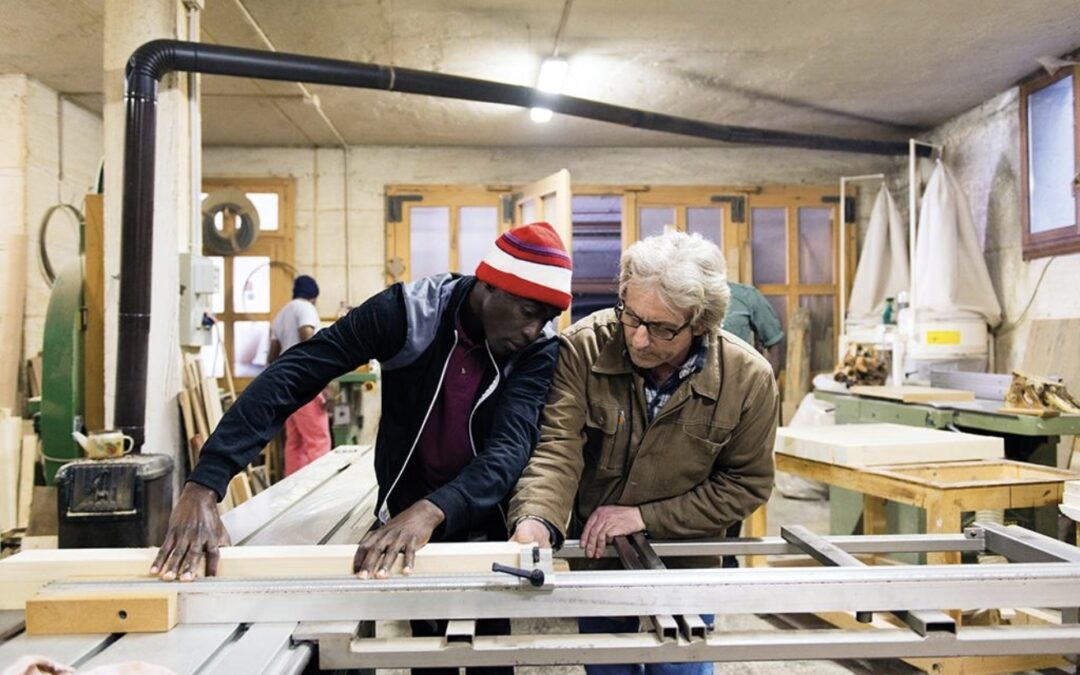
Then people should be trained in their countries of origin: electricians, welders, mechanics, technicians, care workers, skilled tradespeople and other professionals for whom there is a genuine demand.
At the same time, they should learn the Italian language and receive clear information about the rules, rights and responsibilities of the society in which they intend to live.
Finally, where a genuine employment opportunity exists, a regular entry pathway linked to that employment should be established.
With employment, integration can begin from the very first day.
And training remains valuable even for those who ultimately do not leave, because they acquire skills that can also be used in their own country.
When the Failure of Migration Policy Becomes Hostility Towards Islam
There is another particularly delicate consequence.
When some Moroccan, Tunisian, Egyptian or other nationals from Muslim-majority countries repeatedly commit crimes, part of public opinion may begin to associate such behaviour first with nationality and subsequently with religion.
The Moroccan who commits a crime can thus become, in the minds of some people, “the Muslim who commits a crime”.
This association is profoundly wrong.
A criminal does not represent Morocco, Tunisia or Egypt. Above all, that individual does not represent a religion followed by almost two billion people belonging to profoundly different nationalities, cultures and social backgrounds.
However, simply condemning prejudice is not enough.
We must also address the conditions that contribute to creating it.
If the State fails to manage migration flows effectively, if areas of irregularity and marginalization are allowed to become entrenched, if employment and independence are not rapidly encouraged for those entitled to remain, and if effective action is not taken against those who commit crimes, the consequences affect everyone.
They affect the Italian population, which legitimately demands security.
They affect foreign citizens who are lawfully and successfully integrated into society, whose reputation can be damaged by behaviour that does not represent them.
They affect Italian and European Muslims, who may find themselves associated with criminal phenomena that have nothing to do with their faith.
And ultimately, they affect peaceful coexistence between Italians and foreign residents.
Immigration Can Be Managed
We do not believe that immigration is a problem without solutions.
The tools exist.
Entry must be planned according to genuine needs. Training should begin before departure. Legal pathways should be strengthened. Criminal networks organizing irregular migration must be confronted. Employment and independence should be promoted as quickly as possible, and those who arrive must be expected to fully respect the laws of the country in which they live.
At the same time, the truth must be communicated in countries of origin: Europe is not an automatic promise of wealth.
Migration should be an informed and prepared choice, not a leap into the unknown.
The European Muslims League rejects two equally dangerous simplifications: denying the problems associated with immigration and transforming those problems into a condemnation of foreigners or Islam.
Security and dignity are not opposing principles.
Legality and integration are not opposing principles.
An effective migration policy must protect the population, safeguard those who arrive legally, confront those who profit from irregular migration and prevent the mistakes of a few from becoming a collective judgment against millions of people.
Peaceful coexistence is not built by ignoring problems.
It is built by addressing them.
IMMIGRATION AND INTEGRATION: THE PROBLEMS EXIST, AND SO DO THE TOOLS TO ADDRESS THEM